Forward Deployed Engineer (FDE): Role, Skills & Career Guide 2026
What is a Forward Deployed Engineer? Explore the FDE role, skills, AI deployment lifecycle, career path, portfolio, and Pakistan/UAE opportunities in 2026.
Babar Masood
Quick answer: A Forward Deployed Engineer (FDE) works directly with customers or business teams to turn ambiguous operational problems into production software and AI systems. The role typically spans discovery, architecture, implementation, integration, deployment, evaluation, adoption, and measurable business outcomes.
Artificial intelligence has made prototypes dramatically cheaper.
Production deployment is still difficult.
A company can create a chatbot in an afternoon, connect an LLM to documents, ask a coding agent to build an application, or automate an isolated task. But real organisations are not clean demonstrations. They contain legacy software, incomplete data, security boundaries, approval chains, financial controls, undocumented exceptions, regulatory constraints, and people who must trust the system before they will use it.
That gap between AI capability and operational value is where one of the most important emerging engineering roles sits: the Forward Deployed Engineer.
This guide explains what an FDE is, what the role actually does, how it differs from software engineering and consulting, which skills matter, how AI changes the job, how to build an FDE portfolio, and why the role is becoming particularly relevant for enterprise AI in Pakistan, the UAE, and the wider Gulf.
What is a Forward Deployed Engineer?
A Forward Deployed Engineer, usually shortened to FDE, is an engineer who works close to the customer and takes responsibility for turning difficult business problems into working production systems.
The role combines parts of:
- software engineering
- AI engineering
- solution architecture
- technical consulting
- business analysis
- systems integration
- deployment engineering
- product thinking
- customer enablement
The defining characteristic is not the technology stack. It is the scope of ownership.
A conventional engineer may receive a requirement such as “build feature X.” An FDE may receive a much less structured problem such as:
“Our operations team is overwhelmed, information is spread across multiple systems, errors are expensive, and we think AI could help. Figure out what should actually be built.”
That requires more than implementation.
OpenAI currently describes its Forward Deployed Engineers as owning discovery, technical scoping, system design, building, and production rollout while working directly with customer engineering and domain teams. The role is expected to contribute production code and measure whether deployments create workflow impact. See OpenAI Forward Deployed Engineering roles.
AWS has similarly described Forward Deployed Engineering as a model for putting production agentic systems into real customer environments rather than stopping at AI roadmaps. See AWS on Forward Deployed Engineering.
The simplest definition is therefore:
A Forward Deployed Engineer turns ambiguous organisational problems into production systems that create measurable outcomes.
What does an FDE actually do?
The work can be understood in three broad responsibilities.
1. Understand the organisation
Before building anything, an FDE maps the environment in which the solution must survive.
That includes:
- users and stakeholders
- business workflows
- existing applications
- systems of record
- APIs and integrations
- data ownership
- permissions
- policies and controls
- failure cases
- commercial consequences
- compliance requirements
- desired outcomes
The FDE is looking for the real problem, not merely the first requested feature.
2. Build the system
Once the problem is understood, the FDE converts business reality into an executable architecture.
Depending on the problem, that might include:
- web or mobile applications
- APIs
- databases
- queues and event workflows
- authentication and authorization
- AI models
- RAG and retrieval systems
- agents and tool calling
- MCP integrations
- evaluation pipelines
- human approval gates
- observability
- audit trails
A good FDE also decides which parts should not use AI.
3. Operate the outcome
Shipping code is not the finish line.
The FDE needs to ask:
- Is the system reliable?
- Are users adopting it?
- Are AI outputs correct enough for the task?
- What happens when the model is wrong?
- Are tool calls permissioned and auditable?
- What is the latency?
- What does each completed workflow cost?
- How often does a human need to intervene?
- Did processing time fall?
- Did revenue increase?
- Did errors decline?
- Did the system actually improve the business?
That is the difference between an AI demo and a production deployment.
The BabarOnline FDE Lifecycle
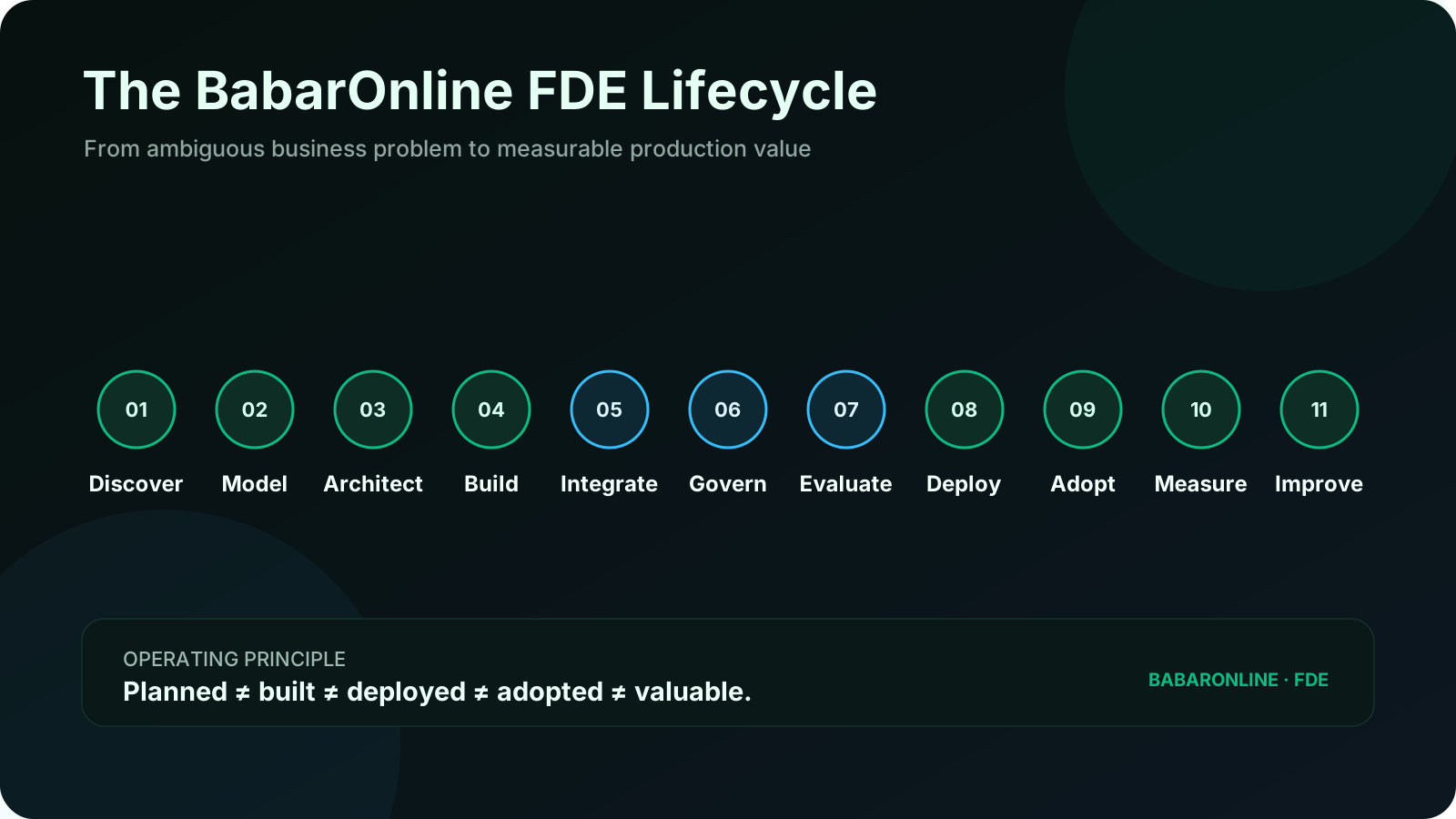
At BabarOnline, we model Forward Deployed Engineering as an eleven-stage operating lifecycle:
Discover → Model → Architect → Build → Integrate → Govern → Evaluate → Deploy → Adopt → Measure → Improve
Discover
Understand the organisation, the workflow, the pain, and the desired outcome before choosing tools.
Model
Translate the workflow into actors, states, events, data, policies, decisions, exceptions, and evidence.
Architect
Choose the smallest reliable combination of deterministic software, AI, infrastructure, and human oversight.
Build
Create the application, service, workflow, agent, integration, or automation.
Integrate
Connect it to the systems the organisation already trusts: ERP, CRM, email, databases, messaging, documents, identity, payments, or internal APIs.
Govern
Define permissions, approval boundaries, budgets, auditability, escalation, sensitive-data controls, and failure behaviour.
Evaluate
Test both deterministic software correctness and probabilistic AI behaviour.
Deploy
Move from controlled testing to production with rollback and observability.
Adopt
Ensure users understand the workflow and can actually use it in their daily work.
Measure
Connect technical metrics to business outcomes.
Improve
Use production evidence to refine the system and turn repeatable patterns into reusable capabilities.
This lifecycle aligns with BabarOnline's wider operating model of Engineering & Development, Traffic Acquisition Systems, and AI & Agentic Automation.
The BabarOnline FDE Value Equation
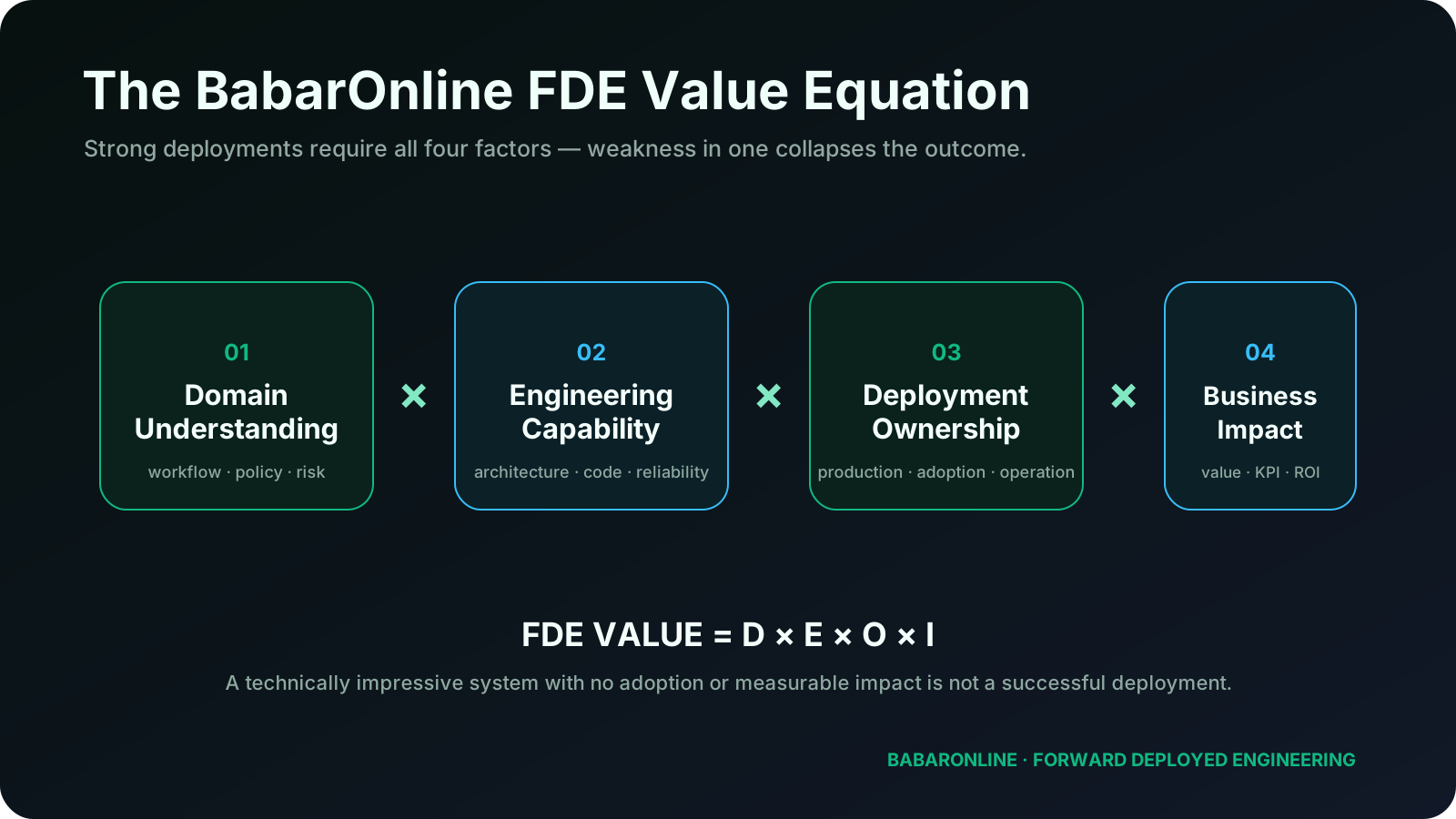
A useful way to think about FDE capability is:
Domain Understanding × Engineering Capability × Deployment Ownership × Business Impact
If any factor approaches zero, the value of the deployment collapses.
An excellent programmer who does not understand the domain can build the wrong system beautifully.
A consultant who understands the organisation but cannot implement the solution remains dependent on another team.
An AI specialist who can create a compelling prototype but cannot productionise it creates experimentation rather than transformation.
And a deployment that technically works but changes no meaningful business outcome has limited value.
Forward Deployed Engineering connects all four.
Why is Forward Deployed Engineering growing?
The intelligence layer is becoming easier to access. Frontier models are available through APIs, open models are improving, and coding agents are reducing the cost of implementation.
The difficult work is moving upward into:
- choosing the right problem
- understanding proprietary workflows
- integrating enterprise systems
- establishing permissions
- defining human approval
- evaluating probabilistic outputs
- controlling cost and latency
- securing sensitive data
- managing exceptions
- driving adoption
- proving commercial value
Indeed data reported by Business Insider showed US FDE job postings rising from 643 in April 2025 to 5,330 in April 2026, approximately 729% growth in one year. See Business Insider's report on FDE hiring growth.
OpenAI now maintains dedicated Forward Deployed Engineering roles across multiple industries and geographies. Anthropic also lists Forward Deployed Engineers and related Applied AI delivery roles. See Anthropic careers.
The market signal is bigger than one job title:
Enterprises increasingly need engineers who can carry AI from model capability to operational reality.
Forward Deployed Engineer vs Software Engineer
Both roles may involve serious software engineering. The difference is primarily where the problem begins and where responsibility ends.
Software Engineer
A software engineer usually works from a product, platform, or engineering context where requirements are at least partially defined.
The central question is often:
How should we build this?
Forward Deployed Engineer
An FDE frequently enters before the requirements are clear.
The questions become:
- What is actually wrong?
- Who owns the workflow?
- Which system is authoritative?
- Should we build anything?
- Should AI be involved?
- Which actions require deterministic guarantees?
- How will the solution fit the customer's environment?
- How will we know it created value?
The FDE therefore works across both the problem space and the solution space.
Forward Deployed Engineer vs AI Engineer
An AI Engineer typically specialises in building AI-powered applications, inference systems, retrieval systems, agents, evaluations, model integrations, or AI infrastructure.
A Forward Deployed AI Engineer takes that capability into the customer's environment.
The distinction can be summarised as:
AI Engineer: builds intelligent systems.
Forward Deployed AI Engineer: deploys intelligent systems into real organisations and owns the path to measurable operational value.
In practice, titles vary. Companies may use Forward Deployed Engineer, Applied AI Engineer, Applied AI Architect, Solutions Engineer, Forward Deployed Software Engineer, or Technical Deployment Lead for overlapping responsibilities.
Evaluate the job description, not the title alone.
Forward Deployed Engineer vs Solutions Architect
A Solutions Architect usually focuses heavily on designing how technologies fit customer requirements.
An FDE often carries the solution further into implementation and production.
The FDE may personally:
- write application code
- create integrations
- build prototypes
- design evaluations
- debug customer environments
- deploy infrastructure
- investigate incidents
- iterate directly with end users
The roles overlap, but FDE work normally emphasizes hands-on deployment ownership.
Forward Deployed Engineer vs Consultant
Consultants are often strong at discovery, process analysis, stakeholder communication, strategy, and operating-model design.
FDEs need many of the same skills.
The key difference is what happens after the recommendation:
The FDE does not merely recommend the transformation. The FDE helps build and deploy it.
This makes FDE a particularly interesting transition for people coming from ERP, enterprise software, cloud implementation, or technical consulting—provided they develop enough hands-on engineering depth.
What skills does a Forward Deployed Engineer need?
There is no universal FDE stack, but the strongest candidates combine several capability groups.
Software engineering foundations
Useful skills include:
- Python
- TypeScript / JavaScript
- APIs
- SQL and PostgreSQL
- frontend and backend development
- authentication and authorization
- Git
- testing
- queues and asynchronous processing
- caching
- Docker
- CI/CD
- cloud deployment
- observability
- system design
- security
AI coding agents can accelerate implementation. They do not remove the need to understand the architecture.
An FDE still needs to answer questions such as:
- Why was this architecture selected?
- What happens when the same request executes twice?
- Where does idempotency live?
- How does the system recover from partial failure?
- What is the source of truth?
- Who can access this data?
- What is logged?
- How do we roll back?
Applied AI engineering
Modern FDEs increasingly need practical knowledge of:
- LLM APIs
- structured outputs
- tool calling
- RAG
- embeddings
- agents
- context engineering
- MCP
- multimodal models
- model routing
- guardrails
- human-in-the-loop workflows
- evaluations
- latency optimisation
- token and inference economics
The goal is not to collect framework names.
The real skill is knowing when to use AI, when to use deterministic software, and when to require a human.
Why AI evals are becoming a core FDE skill
Traditional software is largely deterministic. AI systems introduce probabilistic behaviour.
That means production readiness cannot be assessed with:
“It looked good in the demo.”
An AI deployment needs explicit evaluation.
Possible technical metrics include:
- task success rate
- factual accuracy
- hallucination rate
- retrieval quality
- tool-use correctness
- policy compliance
- escalation rate
- latency
- token consumption
- cost per completed workflow
Then connect those metrics to business outcomes such as:
- processing time
- conversion rate
- operating cost
- customer satisfaction
- error reduction
- revenue
- workload reduction
- resolution time
OpenAI's current FDE descriptions explicitly reference eval-driven feedback and measurable workflow impact. That is an important signal: evaluation is becoming part of enterprise engineering, not only ML research.
For related thinking, see BabarOnline's GEO Framework and LLMO Playbook, which treat visibility and retrieval as systems that need evidence rather than assumptions.
Domain knowledge is part of engineering
Consider a payment workflow.
At first glance, the requirement might be “record payments.”
Production reality may include:
- partial payments
- advance payments
- refunds
- reversals
- discounts
- outstanding balances
- collector attribution
- cash custody
- approval authority
- reactivation rules
- duplicate transactions
- reconciliation
- audit history
A technically valid database record can still represent an operationally incorrect business event.
The same principle applies everywhere.
Healthcare has clinical constraints. Finance has controls and regulatory obligations. Logistics has physical states. Retail has inventory, returns, and fulfillment. Manufacturing has quality tolerances. Government workflows have delegated authority and auditability.
An FDE cannot treat domain knowledge as something another department will explain after the code is written.
Understanding the domain is part of building the correct system.
The FDE Discovery Framework: Who, What, Why, When, Where, How
Before selecting technology, an FDE should be able to answer six basic dimensions.
Who?
Who performs the work? Who approves it? Who receives the result? Who is accountable?
What?
What actually happens? What data is created? What decisions occur? What exceptions exist?
Why?
Why does the process exist? Which outcome, policy, or risk justifies it?
When?
What triggers the workflow? What deadlines exist? What happens when events arrive out of order?
Where?
Where is authoritative data stored? Which systems participate? Where should evidence be recorded?
How?
How is the work currently completed, and how does the organisation know it was completed correctly?
Then go deeper:
- What can fail?
- What does failure cost?
- What requires human approval?
- What must remain deterministic?
- What can AI assist?
- What can AI execute?
- What must be auditable?
- What does success look like after 30, 90, and 365 days?
This is the difference between coding a request and engineering an outcome.
Not every AI workflow needs an agent
The excitement around agentic AI creates a common architecture mistake: turning every process into an autonomous agent.
A strong FDE should distinguish four layers.
Deterministic software
Use deterministic software for rules that must behave predictably: permissions, calculations, financial invariants, state transitions, and database constraints.
AI models
Use models for language, interpretation, classification, generation, summarisation, and uncertain information.
Agents
Use agents when work requires multi-step execution, context, tools, and conditional decisions.
Humans
Use people where judgment, accountability, exception handling, or high-risk approval is required.
A production system may contain all four.
The goal is not maximum autonomy.
The goal is maximum reliable business value.
From AI prototype to production
A useful FDE progression is:
Problem → Discovery → Prototype → Evaluation → Pilot → Production → Adoption → Measured Outcome → Scale
Many AI projects stall between prototype and production because the hard problems emerge late:
- identity and permissions
- dirty data
- security review
- integrations
- model failure
- cost
- latency
- missing evaluation
- user resistance
- unclear ownership
Forward Deployed Engineering exists partly to cross that difficult middle.
BabarOnline applies the same philosophy in its AI & Agentic Automation division: scope the role, connect only necessary systems, apply guardrails, and measure against a real baseline.
What companies hire Forward Deployed Engineers?
Forward deployed roles now appear across frontier AI companies, cloud providers, enterprise software companies, consultancies, and AI-native startups.
Current examples include OpenAI and Anthropic, while AWS has also formalised Forward Deployed Engineering as part of its enterprise AI partner strategy.
This matters because it shows FDE is no longer only a Palantir-associated title. It is becoming a broader industry pattern for customer-embedded technical delivery.
Are there Forward Deployed Engineer jobs in Pakistan?
Yes. FDE and FDE-style AI deployment roles have begun appearing in Pakistan, including positions that combine LLMOps, production GenAI applications, RAG, customer discovery, architecture, and enterprise deployment.
The more important signal is not one employer or one vacancy. It is that Pakistani engineers can now build toward a role whose value is based on combining:
- enterprise understanding
- software engineering
- AI systems
- customer-facing delivery
- deployment ownership
That creates a stronger positioning than competing only as a generic “web developer,” “prompt engineer,” or “AI automation expert.”
For Pakistan-based professionals, the practical path is:
Build locally → prove deployments → document outcomes → compete regionally and globally.
Forward Deployed Engineer careers in the UAE and Gulf
The Gulf is particularly relevant because enterprises and governments across the UAE and Saudi Arabia continue investing heavily in cloud, AI, digital transformation, and intelligent automation.
OpenAI has listed Forward Deployed Engineering and Applied AI roles in Abu Dhabi, demonstrating that the professional category is already part of the regional market.
For engineers in Pakistan and nearby markets, this creates a realistic progression:
- build real production evidence at home
- develop enterprise communication skills
- learn regulated and high-stakes workflows
- strengthen cloud and AI deployment depth
- target UAE and Gulf organisations that need customer-embedded AI implementation
Geography is not the differentiator, however.
Production evidence is.
Do Forward Deployed Engineers need a computer science degree?
Not universally. Requirements vary by employer.
The deeper requirement is competence.
Someone coming from consulting, ERP, operations, or business systems may already understand discovery, process design, stakeholders, and domain rules. Their gap is usually hands-on engineering depth.
Someone coming from software engineering may have the opposite gap: customer discovery, commercial reasoning, stakeholder communication, and domain modelling.
The strongest FDEs deliberately develop both sides.
What programming languages should an FDE learn?
There is no official universal combination, but two languages are particularly practical for AI-oriented Forward Deployed Engineering.
Python
Useful for AI applications, backend services, data processing, automation, evaluation systems, and model tooling.
TypeScript
Useful for full-stack applications, web interfaces, Node.js services, APIs, and modern enterprise applications.
The objective is not collecting languages. It is reaching the point where you can personally defend the architecture of the system you ship.
What belongs in an FDE portfolio?
Do not optimise your portfolio for the number of projects.
Optimise it for evidence.
A strong case study should explain:
Business problem
What was actually wrong?
Discovery
How did you learn what the organisation really needed?
Constraints
What could not be ignored?
Domain model
Which actors, states, events, policies, and exceptions existed?
Architecture
Why was the system designed this way?
AI decision
Why was AI used—or deliberately not used?
Implementation
What did you personally build and verify?
Evaluation
How was correctness measured?
Deployment
How did the system reach production?
Failures
What broke or surprised you?
Adaptation
What changed because of production evidence?
Business result
What became faster, safer, cheaper, more accurate, or more valuable?
A portfolio containing three serious production case studies can demonstrate more FDE capability than dozens of tutorial projects.
Explore BabarOnline's selected systems and case studies for examples of how production evidence can be separated from future targets.
Certification vs capability
Certifications can provide structure and portable proof of specific knowledge.
They should not replace deployment evidence.
Anthropic now offers role-oriented Claude certifications covering areas such as model use, agentic architecture, tools, MCP, application integration, and solution design. See Anthropic certification resources.
A useful principle is:
Certification can demonstrate knowledge. Deployment demonstrates capability.
For an FDE career, ideally build both.
The BabarOnline FDE Maturity Model
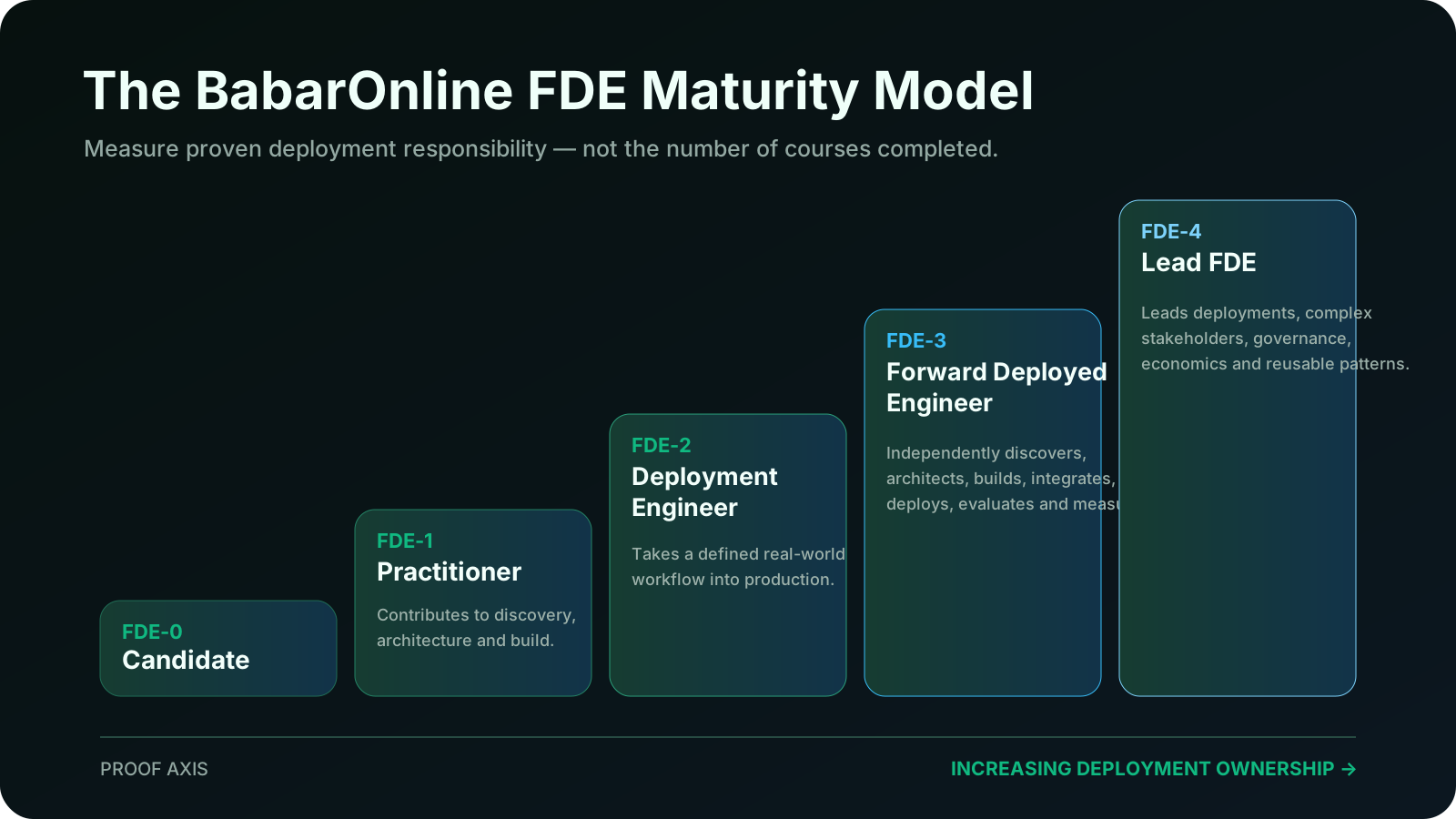
Instead of asking only “have I completed a course?”, evaluate the level of deployment responsibility you can prove.
FDE-0 — Candidate
Understands the role and foundational technologies.
FDE-1 — Practitioner
Can contribute to discovery, architecture, and implementation with guidance.
FDE-2 — Deployment Engineer
Can take a defined real-world workflow into production.
FDE-3 — Forward Deployed Engineer
Can independently discover, architect, build, integrate, deploy, evaluate, and measure a customer solution.
FDE-4 — Lead FDE
Can manage multiple deployments, complex stakeholders, architecture, governance, economics, reusable patterns, and other engineers.
The useful question becomes:
What level of deployment responsibility can I prove?
How to become a Forward Deployed Engineer
A practical roadmap is more useful than another giant list of technologies.
Stage 1 — Strengthen software foundations
Build APIs, databases, authentication, workflows, and production applications.
Stage 2 — Learn applied AI engineering
Understand LLM APIs, structured outputs, RAG, agents, tool calling, MCP, evaluations, and human-AI workflows.
Stage 3 — Learn discovery
Practice analysing organisations before selecting technology.
Stage 4 — Work on real workflows
Move beyond toy projects. Find processes with real users, rules, data, and consequences.
Stage 5 — Deploy
Put systems in front of actual users. Production reveals assumptions that tutorials hide.
Stage 6 — Measure
Track technical and business outcomes.
Stage 7 — Document
Turn the work into case studies that explain decisions, failures, and results.
Stage 8 — Repeat across another domain
Show that your deployment discipline transfers beyond one application.
What makes a great FDE?
A great Forward Deployed Engineer can enter an unfamiliar organisation and progressively create clarity.
They can talk to a CEO about business outcomes.
They can talk to operations about workflow reality.
They can talk to finance about controls and economics.
They can talk to security about risk.
They can talk to engineers about architecture.
They can talk to users about adoption.
Then they can make those perspectives meet inside one functioning system.
That combination is rare.
Which is precisely why it is valuable.
Frequently asked questions about Forward Deployed Engineers
What does FDE stand for?
FDE stands for Forward Deployed Engineer.
What is a Forward Deployed Engineer in simple terms?
A Forward Deployed Engineer works directly with customers or business teams to understand difficult operational problems and build technical systems that work in production.
Is an FDE a software engineer?
Usually yes, software engineering is a core capability. The role generally adds broader responsibility for discovery, customer interaction, integration, deployment, adoption, and business outcomes.
Is an FDE an AI Engineer?
Not necessarily. Forward Deployed Engineering predates the current generative AI wave. However, AI-focused FDE roles are expanding because enterprises need people who can operationalise LLMs, agents, and AI workflows.
What is a Forward Deployed AI Engineer?
A Forward Deployed AI Engineer is an FDE specialising in production AI systems such as LLM applications, RAG, agents, evaluations, and AI-enabled enterprise workflows.
Do FDEs need to code?
In engineering-oriented FDE roles, yes. The ability to contribute directly to production code is a major part of the role at companies such as OpenAI.
What skills matter most?
The strongest combination is software engineering + system design + customer discovery + domain understanding + deployment + communication + business judgment.
Is Forward Deployed Engineering a good career in 2026?
The market is expanding quickly and major AI companies are building dedicated FDE or Applied AI deployment organisations. That does not guarantee individual outcomes, but it is a strong demand signal for engineers who can turn AI capability into production value.
Are there FDE jobs in Pakistan?
Yes. FDE and closely related production-AI roles have started appearing in Pakistan. Candidates can strengthen their position by building real local deployments and using them as evidence for regional and global roles.
Are there FDE jobs in the UAE?
Yes. Forward Deployed Engineering and Applied AI roles have been listed in Abu Dhabi and elsewhere in the Gulf enterprise AI ecosystem.
Do I need machine-learning research experience?
Not necessarily. Most FDE work is applied engineering rather than frontier-model research. Understanding model behaviour matters, but the emphasis is typically integration, reliability, evaluation, and business deployment.
Is prompt engineering enough?
No. Prompting is useful, but the profession requires a much broader stack: software engineering, architecture, integrations, data, evaluation, deployment, security, customer discovery, and operations.
Can a consultant become an FDE?
Yes. Consultants often already possess discovery and stakeholder skills. The main requirement is to develop enough engineering depth to build and own production systems.
Can a software engineer become an FDE?
Yes. Software engineers often need to strengthen customer discovery, domain modelling, business communication, and end-to-end deployment ownership.
The bigger shift: from building features to engineering outcomes
Software engineering historically optimised the production of software.
AI is making software production cheaper.
That pushes professional value upward toward judgment.
The important questions increasingly become:
- What should we build?
- Why?
- For whom?
- What should AI control?
- What must remain deterministic?
- Where must humans remain accountable?
- How can the system fail?
- How do we evaluate it?
- How does it create measurable value?
Forward Deployed Engineering represents a change in the unit of engineering responsibility:
from feature delivered to outcome achieved.
The FDE is ultimately an outcome engineer
The profession combines:
engineering + domain understanding + AI capability + customer proximity + deployment ownership + business accountability.
As organisations move from experimenting with artificial intelligence toward actually operating with it, that combination becomes more important.
The future engineer may spend less time manually typing every line of code.
But somebody still has to understand the business.
Somebody still has to design the system.
Somebody still has to define what correct means.
Somebody still has to validate AI behaviour.
Somebody still has to take the deployment into production.
And somebody still has to answer the most important question:
Did it actually work?
That is the opportunity behind the rise of the Forward Deployed Engineer.
Build your FDE capability
If you want to move toward Forward Deployed Engineering, begin with one real workflow.
Do not start with:
“Which AI framework should I learn next?”
Start with:
“What real operational problem can I understand deeply enough to improve—and can I prove the result?”
Then:
Discover it. Model it. Architect it. Build it. Evaluate it. Deploy it. Measure it. Improve it.
That is how Forward Deployed Engineers are made.
About BabarOnline
BabarOnline is a technology-enabled growth and transformation company connecting digital infrastructure, software engineering, traffic acquisition, and governed AI automation around measurable commercial outcomes.
Our focus is the difficult work between business problem → architecture → implementation → production → measurable value.
Explore Engineering & Development, Traffic Acquisition Systems, AI & Agentic Automation, or contact BabarOnline to discuss a production AI or workflow transformation project.
Primary sources and further reading
- OpenAI — Forward Deployed Engineering careers
- AWS — Forward Deployed Engineering for enterprise AI
- Anthropic — Careers and Applied AI roles
- Anthropic — Certification resources
- Business Insider — FDE job-posting growth reported from Indeed data
Research note: Job openings, certification details, and market conditions change. This guide is maintained as an evergreen BabarOnline knowledge asset and should be substantively re-verified before changing its visible “last updated” date.
Turn an AI idea into a production outcome.
Babar Online combines engineering, traffic acquisition, and governed AI automation around measurable business workflows.
Book Strategy Session